
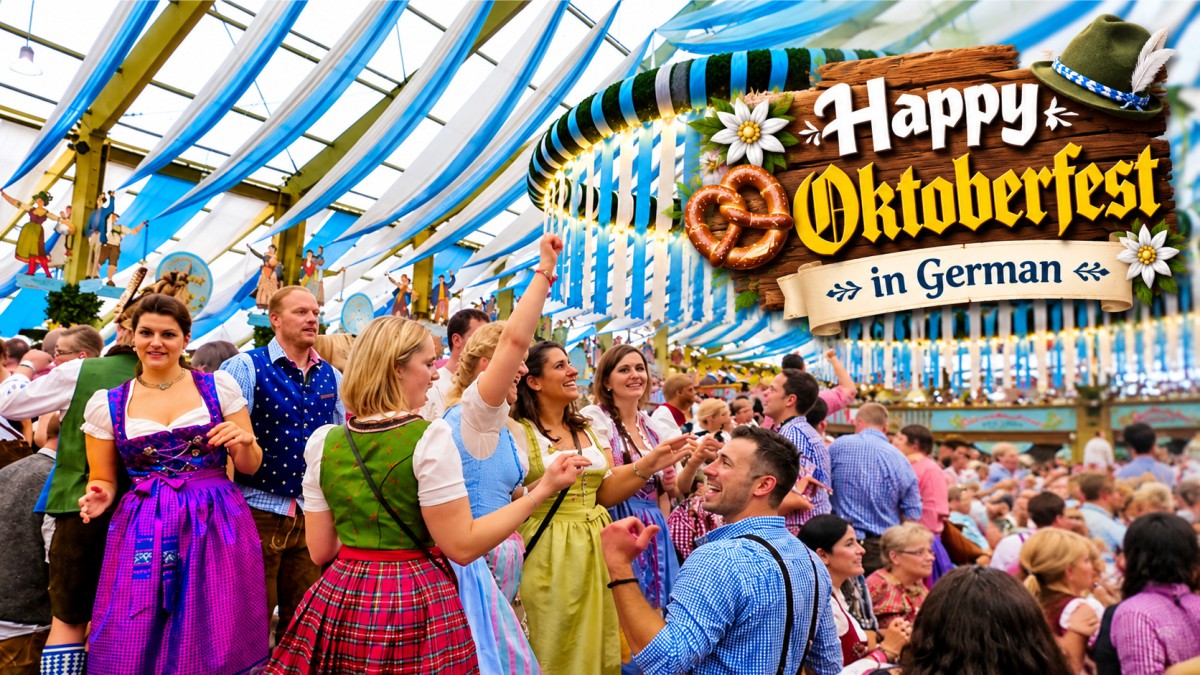
“Happy Oktoberfest” in German would be Frohes Oktoberfest! (FROH-es ok-TOH-ber-fest). Although the phrase “Frohe Oktoberfest” is sometimes found in English-language guides, Oktoberfest is a neuter noun in German, so the grammatically correct form is Frohes Oktoberfest. Germans will understand the phrase, but in Munich, people more naturally wish each other a good time with Viel Spaß auf der Wiesn!
This is a guide to the actual words people say, how to say them, how to toast properly, how to order a beer, and facts about 2026 and the next festival. Each German phrase is accompanied by its translation in English.
Key point: The direct German greeting is “Frohes Oktoberfest!”, while “Viel Spaß auf der Wiesn!” is a more natural way to wish someone a good time at the festival.
Why it’s “Frohes” and not “Frohe”
German adjectives agree with the gender of the noun. Das Oktoberfest is neuter, so the adjective needs to be followed by- es, e.g. frohes, schönes. Feminine nouns and plurals use the ending -e (e.g. frohe Weihnachten (Merry Christmas) and frohe Ostern (Happy Easter)). The word “Frohe Oktoberfest” is a common phrase in many popular English guides, and a German reader will see it right away.
The second catch is here. The greeting Frohes… is a holiday greeting, similar to Frohes neues Jahr (Happy New Year). Oktoberfest is not a public holiday, so it can be a word-for-word translation. It still looks good for signs, party invitations, cards and social posts, and is festive. A desire for fun is more natural when talking to someone else, or writing a personal message to a German friend: “Ein schönes Oktoberfest! Wishing you a wonderful Oktoberfest! (Have fun at Oktoberfest).
What Germans actually say at the Wiesn
Very few locals actually say “Oktoberfest” at any time. The festival, which is held at the meadow in Munich where it gets its name, the Theresienwiese (VEE-zn), is said to die. The meadow got its name from the tradition of initiating it at the wedding of Princess Therese to Crown Prince Ludwig of Bavaria in October 1810. The celebrations were held from 12-17 October, and there was a huge turnout for the 17th horse race. The festival was repeated the following year and is now an annual event. Folgt man den Tendenzen der Zeit, dann hört man: “auf die Wiesn gehen” und “auf der Wiesn sein“.
The natural wishes and greetings are:
- Viel Spaß auf der Wiesn! Many visitors wear traditional clothing, so getting the lederhosen fit right helps keep you comfortable.
- Schöne Wiesn! A quick, casual version, like “enjoy the Wiesn.”
- Auf geht’s zur Wiesn! Off to the Wiesn! Said when you are heading out with friends.
- Willkommen zum Oktoberfest! or Willkommen auf der Wiesn! Welcome to Oktoberfest, used by hosts and on signs.
If someone wishes you a good festival, answer with “Danke, gleichfalls!”, which means “Thanks, you too.”
Munich locals often speak with a Bavarian accent and vocabulary, but standard German (Hochdeutsch) is always understood. If you are learning, stick to standard forms and add a Bavarian word or two for flavour.
Quick reference: Oktoberfest phrases in German
Here are the phrases you will use most, in one place.
| German | Say it like | Meaning in English |
| Frohes Oktoberfest! | FROH-es ok-TOH-ber-fest | Happy Oktoberfest |
| Ein schönes Oktoberfest! | ine SHUR-nes ok-TOH-ber-fest | Have a lovely Oktoberfest |
| Viel Spaß auf der Wiesn! | feel shpahss owf dair VEE-zn | Have fun at the Wiesn |
| Willkommen zum Oktoberfest! | vil-KOM-en tsoom ok-TOH-ber-fest | Welcome to Oktoberfest |
| Servus! | ZER-vooss | Hello / goodbye (Bavarian) |
| Grüß Gott! | groos got | Hello (traditional Bavarian) |
| Prost! | prohst | Cheers |
| Zum Wohl! | tsoom vohl | To your health (more formal) |
| O’zapft is! | oh-TSAHPFT iss | It’s tapped! (the opening call) |
| Oans, zwoa, drei, g’suffa! | ohns tsvoh dry guh-ZOOF-ah | One, two, three, down it goes |
| Eine Maß, bitte. | EYE-neh mahss BIT-teh | One liter of beer, please |
| Ist hier noch frei? | ist heer nokh fry | Is this seat free? |
| Zahlen, bitte! | TSAH-len BIT-teh | The bill, please |
| Danke, gleichfalls! | DAHN-keh GLYKH-fals | Thanks, you too |
Everyday greetings in Munich
Bavaria has its own greetings, and using them is the easiest way to show you have done your homework.
- Servus works as both hello and goodbye. It is friendly, informal and very Bavarian.
- Grüß Gott (literally “God greet you”) is the traditional Bavarian hello and a bit more formal. You will hear it in shops and from older people.
- Hallo and Guten Tag (good day) are safe anywhere in Germany.
- Pfiat di (pfee-at dee) is the Bavarian goodbye. Tschüss is the standard version.
- Mahlzeit is a greeting around lunchtime, and you will often hear it when food arrives.
Cheers and Toasts
At Oktoberfest, you’ll hear several German and Bavarian cheers throughout the celebrations.
Prost! — The most common German toast, meaning “Cheers!”
Zum Wohl! — A slightly more formal way to say “Cheers!”
“Ein Prosit der Gemütlichkeit” — A famous Oktoberfest drinking song celebrating good company and a cheerful atmosphere.
“O’zapft is!” — Bavarian for “It’s tapped!” It is traditionally announced when the first keg is tapped at Oktoberfest.
“Oans, zwoa, drei, g’suffa!” — A Bavarian drinking chant meaning roughly “One, two, three, drink!”
“Zicke zacke, zicke zacke, hoi hoi hoi!” — A rhythmic Oktoberfest cheer often shouted by the crowd.
Ordering and paying at the Wiesn
Servers move fast and the tents are loud, so know what you want before they arrive.
- Eine Maß, bitte. One liter of beer, please. The beer mug is die Maß, a feminine noun, so it is eine, not ein. Several competing guides get this wrong.
- Noch eine Maß, bitte. Another one, please.
- Ein Radler, bitte. A beer mixed with lemon soda. A good choice if you want to pace yourself.
- Ein Hendl, bitte. A roast chicken, the classic Wiesn meal.
- Eine Brezn, bitte. A pretzel.
- Ist hier noch frei? Is this seat free? Ask before joining a half-empty table.
- Sprechen Sie Englisch? Do you speak English? Most staff do, but a German opener is appreciated.
- Das ist mein erstes Oktoberfest. This is my first Oktoberfest. It is a great icebreaker.
- Ich lade euch ein. This round is on me.
Reserved tables: a slip of paper on the table shows the time from which it is reserved. Do not sit at a table marked Reserviert (reserved) or Stammtisch (a regulars’ table). If a table looks empty but is reserved, you may have to give it up when the group arrives.
Paying and tipping: the server usually collects payment when the drinks arrive. To tip, say the total you want to pay including the tip. If the bill is €15 and you want to leave €3, say “Achtzehn” (eighteen) and hand over a €20 note. They will give you €2 back. A tip of roughly 5 to 10 percent is typical, and it is worth being generous on the first round because the same person usually looks after your table all evening. Stimmt so means “keep the change.” Bring cash, since not every tent takes cards, and carry coins for the restrooms.
Words you will see and hear
- Wiesn: the local name for Oktoberfest.
- Maß: the one-liter beer mug (mahss). Some people spell it Mass, without the ß.
- Festzelt: a festival tent.
- Bedienung: the server. Waitresses are also called Kellnerin.
- Kapelle / Kapellmeister: the band and its conductor.
- Tracht: traditional Bavarian clothing, including the Dirndl (dress) and Lederhose (leather trousers).
- Schunkeln: swaying arm-in-arm on the benches to the music.
- Stammtisch: a table kept for a regular group.
- Bierleichen: “beer corpses,” the affectionate word for people who have had far too much.
Signs and captions for your own party
If you are hosting your own Oktoberfest party, these German signs work as written:
- Willkommen zum Oktoberfest: welcome to Oktoberfest
- Zur Wiesn: to the Wiesn (add an arrow)
- Brezn & Bier: pretzels and beer
- Eingang / Ausgang: entrance / exit
- Toiletten: restrooms
- Reserviert: reserved
And here are a few original captions for photos, free to use:
- Frohes Oktoberfest! Pretzels first, decisions later.
- Prost to everyone who shared their bench.
- One Maß, zero regrets, plenty of Brezn.
- Dirndl on, phone away, Prost.
Spelling and pronunciation
- It is Oktoberfest with a K, written as one word. “Octoberfest” and “October Fest” are the usual misspellings.
- Wiesn is roughly VEE-zn. Maß rhymes with “pass,” and the ß sounds like a double s. Brezn is roughly BRAY-tsn.
- If you cannot type the ß, Mass is an accepted fallback.
- The festival is in September despite the name. It moved earlier to give visitors better weather.
For everyday vocabulary beyond the festival, see these German greetings and phrases.
FAQ
How do you wish someone a happy Oktoberfest in German?
You can say “Frohes Oktoberfest!” when you want to give a direct “Happy Oktoberfest!” greeting. If you want to wish someone a good time at the festival, “Viel Spaß auf der Wiesn!” is a natural alternative.
What should you say when someone wishes you a happy Oktoberfest in German?
You can respond with “Danke, gleichfalls!”, which means “Thanks, you too!” It is a simple way to return the good wishes.
What do Germans say during Oktoberfest?
Mostly Prost (cheers), Servus (hello), Grüß Gott (a traditional hello) and Eine Maß, bitte (one liter of beer, please). The opening call is O’zapft is!
What do they yell at Oktoberfest?
Usually Prost!, Zicke zacke, hoi hoi hoi! and Oans, zwoa, drei, g’suffa!
What does “Zicke zacke” mean?
It has no literal meaning. It is a rhythmic cheer, and the crowd answers with hoi hoi hoi.
