

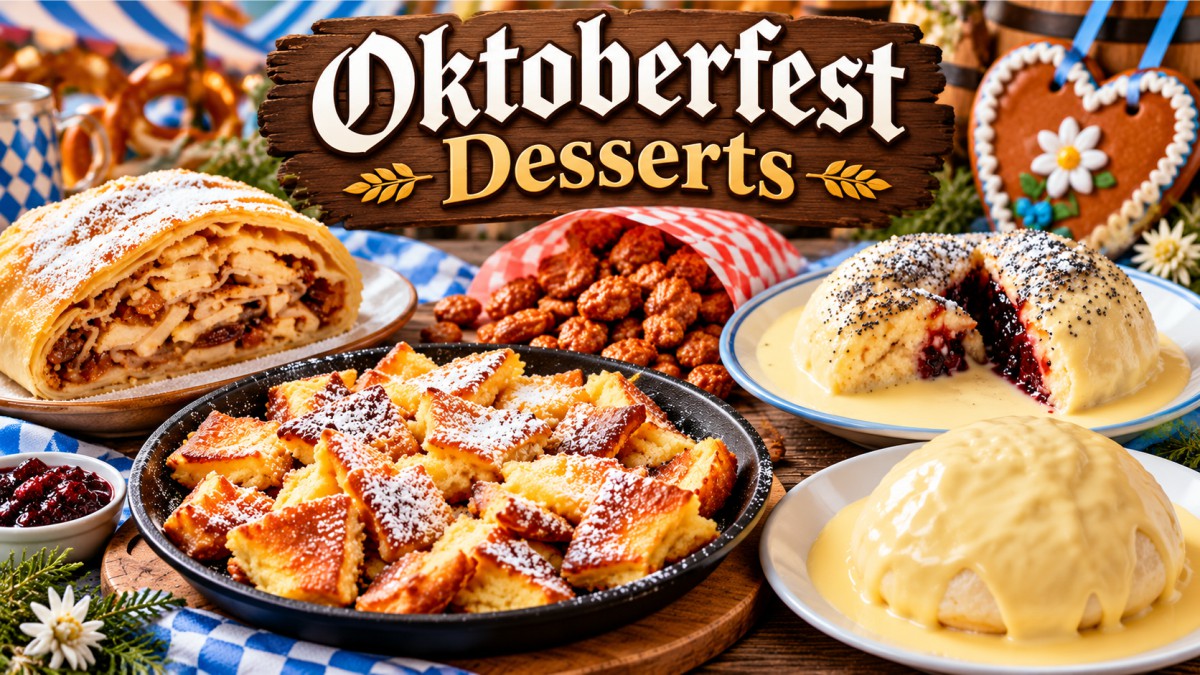
Oktoberfest desserts are sweet treats that are traditionally enjoyed at the Munich Oktoberfest. You can find a variety of traditional Bavarian and German sweets, such as Kaiserschmarrn (shredded sweet pancakes), Dampfnudeln (steamed sweet dumplings), Germknödel (yeast dumplings filled with plum jam), Lebkuchen hearts, roasted almonds, and Apfelstrudel (apple strudel). Some are light snacks, while others are rich and filling enough to serve as a meal on their own.
We checked what German sources list. One German food magazine names four sweet staples of the festival: Dampfnudeln with vanilla sauce, roasted almonds, Lebkuchen hearts and Kaiserschmarrn. The city’s Oktoberfest site also points to Café Rischart’s Kaiserschmarrn as a well-known favourite. Most other sweets in this guide come from Bavarian, Austrian and Swabian baking.
So, which Oktoberfest desserts are worth trying, and which ones are best for making at home? This guide covers the traditional sweets you can find at the Wiesn, popular German desserts for an Oktoberfest party, an easy Spritzkuchen recipe, dietary options, drink pairings, and tips for finding Oktoberfest desserts near you. Let’s start with the quick facts.
Oktoberfest Desserts at a Glance
- Most famous: Kaiserschmarrn, Dampfnudel, Germknödel, Apfelstrudel, and roasted almonds.
- Best souvenir: Lebkuchenherz, a decorated gingerbread heart.
- Best walking snack: Warm Gebrannte Mandeln (candied almonds).
- Best to make ahead: Bavarian cream and plum cake.
- Best meal-sized sweets: Dampfnudel and Germknödel.
- Easiest to make at home: Kaiserschmarrn.
- Not traditional Wiesn staples: Black Forest cake and German chocolate cake.
What Are Traditional Oktoberfest Desserts?
Traditional Oktoberfest desserts are sweet dishes from Bavaria and its neighbours. Some are Bavarian. Others come from Austria or Swabia, and the festival adopted them. Kaiserschmarrn started in Austria. Germknödel is a speciality of both Austria and Bavaria.
In Bavaria, a sweet dish can be the main course. Kaiserschmarrn and sweet dumplings often replace the meat dish. Coffee and cake are also an everyday habit.
Bavaria’s sweets belong to wider German culinary traditions. The German National Tourist Board describes German cuisine as rooted in the region and interpreted in a modern way. For the savory side of the celebration, traditional Oktoberfest dishes such as sausages, roast chicken, pretzels, and other Bavarian favorites are just as important as the sweets.
Popular Oktoberfest Desserts and Sweets at the Wiesn
- Kaiserschmarrn (shredded pancake)
- Dampfnudel (steamed sweet dumpling)
- Germknödel (yeast dumpling filled with plum jam)
- Apfelstrudel
- Apfelküchle (Apple Fritters)
- Zwetschgenknödel and Marillenknödel
- Auszogne, Schmalznudeln and Krapfen
- Gebrannte Mandeln (Candied Almonds)
- Lebkuchenherz (Gingerbread Heart)
1.Kaiserschmarrn
Kaiserschmarrn is a fluffy pancake that cooks tear into pieces and caramelize in the pan. Traditionally, it’s served with applesauce or plum compote. In Austria, the batter uses the same ingredients as crepes. Some versions add rum-soaked raisins. It’s rich, so share one. It also scales well for a crowd.
2.Dampfnudel
Dampfnudel is a yeast dumpling with no filling. Bavarian Dampfnudeln are steamed in milk and butter, then lightly fried at the end, and are always served sweet. Vanilla sauce is the classic accompaniment. The bottom crisps and the top stays soft. Order it as a meal, not a side.
3.Germknödel
Baked yeast dumpling called Germknödel is traditionally filled with spiced plum jam and topped with melted butter, poppy seeds, and sugar. Vanilla sauce is an unconventional addition to this sweet dish, so it is better to eat it with a glass of black coffee to avoid an overly sweet taste.
4.Apfelstrudel
Apfelstrudel is a traditional pastry dish that consists of apples, raisins and cinnamon, wrapped in very thin dough. Apple strudel is a Bavarian speciality, even if the pastry is, in fact, Central European. It is warm, served with a vanilla sauce or ice cream. However, in the home, we can save hours of work by using ready-made sheets of filo or puff pastry.
5.Apfelküchle (Apple Fritters)
Apfelküchle are apple rings in batter, fried and dusted with sugar. Cooks serve them with creamy vanilla sauce or a white wine zabaglione. Eat them hot. They go soft as they cool.
6.Zwetschgenknödel and Marillenknödel
Zwetschgen or Marillenklöppelchen. In the Alps, dumplings stuffed with fruit are a popular dessert. Search for them in autumn when plums are in season.
7.Auszogne, Schmalznudeln and Krapfen
These fried yeast pastries have a number of different names. The same pastry is used to make A-Typen like Auszogne, Krapfen, Küchle and Schmalznudel. Bakers spread out the dough thin in the middle and thick at the edges. Fry in lard and sprinkle with powdered sugar. They are believed to be related to Volksfests, e.g., the Oktoberfest in Bavaria. Be aware that in northern Germany Krapfen can refer to a filled doughnut, and in Magdeburg, there is a small pastry called Schmalzkuchen.
8.Gebrannte Mandeln (Candied Almonds)
Almonds roasted in caramelised sugar make the smell of the fairground. They taste best warm. At a party, serve them in paper cones as guests arrive.
9.Lebkuchenherz (Gingerbread Heart)
The Lebkuchen hearts are decorated gingerbreads. The German media refers to them as a sweet classic and popular memento. They are baked for a longer time and result in a firm gingerbread. They can be consumed, but most visitors will take them home as a memento.
Tip: If you’re trying several Oktoberfest desserts, order smaller portions or share them. Desserts like Kaiserschmarrn and Dampfnudel are quite filling, while roasted almonds and Lebkuchenherzen are easier to enjoy as snacks.
Classic German Sweets to Serve at Oktoberfest
These sweets don’t all come from the Wiesn. They suit an Oktoberfest dessert table.
- Bayerische Creme (Bavarian cream): a light, creamy vanilla custard made from milk and thick cream. Serve it with berries.
- Zwetschgenkuchen and Streuselkuchen: a yeast plum cake with a crumb topping. Names change by region, including Zwetschgendatschi.
- Bienenstich (bee sting cake): yeast dough, vanilla custard and honey-caramelised almonds.
- Prinzregententorte: a Bavarian layer cake with chocolate buttercream and apricot jam.
- Rote Grütze: a red berry pudding with cream or vanilla sauce. It comes from northern Germany, but it fits the table.
- Käsekuchen: German cheesecake made with quark. It’s lighter than the American kind.
Easy Recipe: Glazed Fried Dough Rings (Spritzkuchen)
Spritzkuchen are German crullers. They’re popular during Karneval and at other festivals, and the dough is choux pastry, so there’s no yeast and no rising time. They aren’t a Wiesn staple, but they look great on a party table.
Ingredients
- 1 cup milk
- 1 pinch of salt
- 1 tablespoon sugar
- 4 tablespoons butter
- 1¼ cups flour
- 3 eggs
- Vegetable oil, for frying and for the parchment
Glaze
- 1¼ cups powdered sugar
- 3 tablespoons milk
Steps
- Heat the milk, salt, sugar and butter in a saucepan until it boils.
- Take the pan off the heat. Add all the flour at once and stir fast.
- Move the dough to a mixer. Add the eggs one at a time. Mix until smooth before each new egg.
- Cut parchment into squares and brush each with oil.
- Pipe 3-inch rings onto the squares with a large tip.
- Heat 2 to 3 inches of oil to about 180°C (350°F). Fry the rings until golden brown.
- Mix the glaze until smooth. Dunk each ring once it cools a little.
- Set the rings on a rack over a drip pan.
Serve them fresh. German crullers taste best the day you make them. Keep children away from the hot oil.
Vegetarian, Vegan and Gluten-Free Notes
Most Oktoberfest desserts are vegetarian, but they use eggs and dairy. Most also use wheat flour. Candied almonds are usually the simplest choice for people who avoid gluten, but check the ingredients.
Watch for lard. Traditional Auszogne fry in lard. Ask before you order if you avoid animal fat. Almonds and Bienenstich contain nuts.
What to Drink with Oktoberfest Desserts
One pairing guide suggests Apfelstrudel with Riesling or coffee, Dampfnudel with a dark Dunkel beer and Kaiserschmarrn with a light Weißbier. It also pairs roasted almonds with a Bock. Treat these as ideas, not rules.
Where to Find Oktoberfest Desserts Near You
Start with German bakeries, delis and restaurants. Many bake Apfelstrudel and plum cake in autumn. Check the vendor list for any Oktoberfest event before you go. Sweet stalls often sell almonds and fried dough.
Georgia has a famous option. The official Helen Oktoberfest runs nightly from October 1 to November 1, 2026, at the Helen Festhalle.
If you bake at home, look for German baking items at a German grocer or online. Useful items include vanilla sugar, Powidl (plum butter), poppy seeds and quark. Check labels for gluten, dairy and eggs.
If you are attending a local Oktoberfest event, you can also make the experience more authentic by wearing traditional German clothing, such as Lederhosen or a Dirndl, while enjoying the food and desserts.
Common Mistakes to Avoid
- Serving Black Forest cake or German chocolate cake as “authentic.” Black Forest cake comes from southwest Germany. German chocolate cake is American.
- Making everything the same day. Prepare the cold desserts the night before.
- Letting fried desserts sit. Fritters and fried dough go soft fast.
- Skipping the sauce. Dampfnudel and Germknödel need vanilla sauce or melted butter.
Oktoberfest Desserts FAQ
What are the best Oktoberfest desserts?
Kaiserschmarrn, Dampfnudel, Germknödel, Apfelstrudel and roasted almonds top most lists. Lebkuchen hearts are a famous souvenir.
What dessert do you eat at Oktoberfest in Munich?
Most visitors try Kaiserschmarrn or a sweet dumpling. At stalls, they grab candied almonds.
Is Kaiserschmarrn German or Austrian?
It started in Austria. Bavaria loves it, and Munich’s festival serves it every year.
What’s the difference between Dampfnudel and Germknödel?
Germknödel has a plum-jam filling. Dampfnudel has none. Bavarian Dampfnudeln steam in milk and butter and crisp lightly at the end.
Can you eat the Lebkuchen hearts?
Yes, but most people keep them as souvenirs.
What are easy Oktoberfest desserts for a crowd?
Kaiserschmarrn, Bavarian cream in glasses, roasted almonds and plum cake all scale well.
Are Oktoberfest desserts vegetarian?
Most are. Some fried pastries use lard, so ask the vendor.
What are Schmalzkuchen?
In Bavaria, Schmalznudeln are another name for Auszogne. Magdeburg’s Schmalzkuchen are a different, small northern pastry.
What drinks go with Oktoberfest desserts?
Coffee suits most. Riesling, Dunkel or Weißbier work with specific sweets.
Where can I buy Oktoberfest desserts near me?
Try German bakeries and delis, or check the vendor list for a local Oktoberfest event.
