
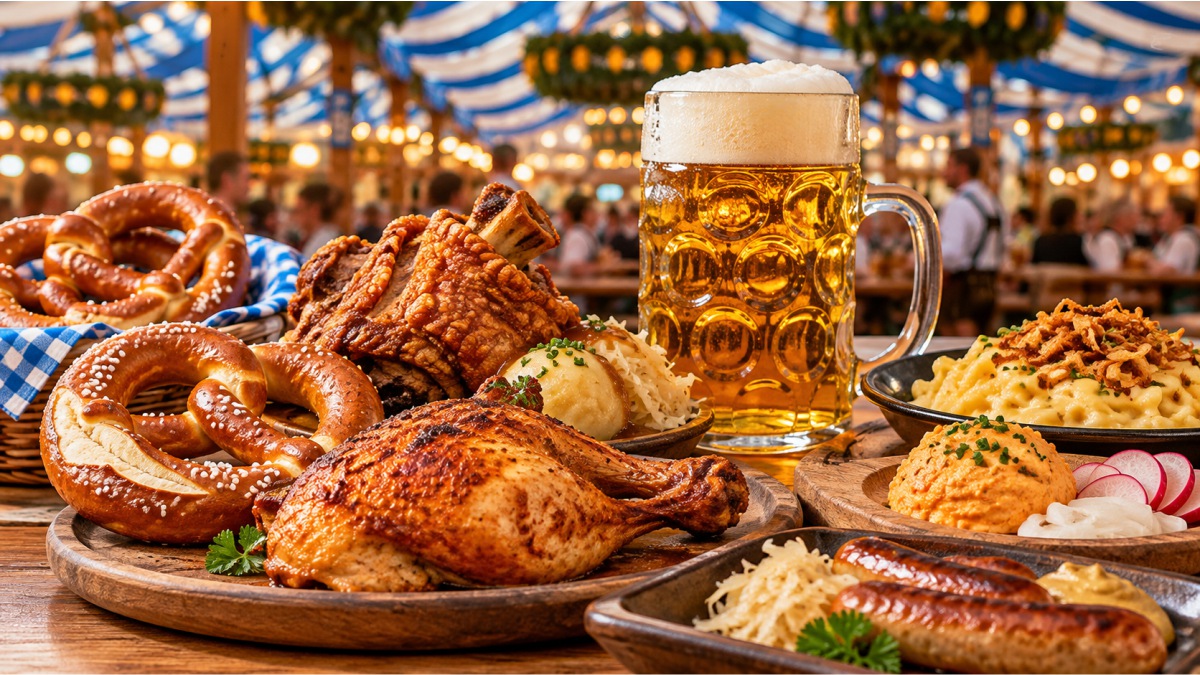
Oktoberfest food is the Bavarian menu served at Munich’s Oktoberfest, locally known as the Wiesn. It includes whole-grilled meats, sausages, cold platters called Brotzeit, dumplings, pretzels, and sweet dishes. Popular choices include half roast chicken (Wiesn-Hendl), pork knuckles (Schweinshaxe), giant pretzels (Brezn), cheese spread (Obatzda), and sausages with sauerkraut. The food is designed for long days in huge beer tents, where up to 10,000 people can sit in a single marquee.
The menu also feeds a crowd. The 2025 festival drew 6.5 million visitors and served 6.5 million Maß of beer, according to the city’s official Wiesn figures. At the 2025 halfway point, the large tents reported food sales were up 5 to 8 percent, excluding chicken, while chicken demand remained flat. Prices vary by dish and tent, with a typical meal costing around €12 to €35 and a half chicken costing about €18 to €25.
So what should you order? This guide covers the main dishes, their prices, and what to expect from each one. You’ll also find vegetarian options, practical tips, and ideas for bringing the Oktoberfest menu home for a party. Let’s start with the dishes.
Quick Answer: What Should You Eat at Oktoberfest?
Oktoberfest Food Menu: A Quick Decoder
| German name | In plain English | Meat-free? |
| Hendl | Half roast chicken | No |
| Schweinshaxe | Roast pork knuckle with crackling | No |
| Steckerlfisch | Fish grilled on a stick | Fish only |
| Käsespätzle | Egg noodles with cheese and fried onions | Yes (ask about bacon) |
| Brezn | Giant soft pretzel | Yes (contains gluten) |
| Obatzda | Camembert and butter spread | Yes |
| Radi | Spiral-cut salted white radish | Yes |
| Weißwurst | White veal sausage in hot water | No |
| Schweinswürstl mit Sauerkraut | Pork sausages with sauerkraut | No |
| Ochsenbraten | Roast ox | No |
| Brotzeitbrettl | Cold platter to share | Mixed |
| Kaiserschmarrn | Shredded caramelised pancake | Yes |
| Gebrannte Mandeln | Warm candied almonds | Yes |
The Traditional Oktoberfest Foods You Need to Try
1. Wiesn-Hendl (Half Roast Chicken)
Most people will mention the Hendl as the dish. Half chicken, roasted with crisp skin and juicy meat, it usually includes a pretzel. It costs roughly €18 to €25. It suits first-timers and anyone who wants one safe, filling order. Use your hands, which is normal here.
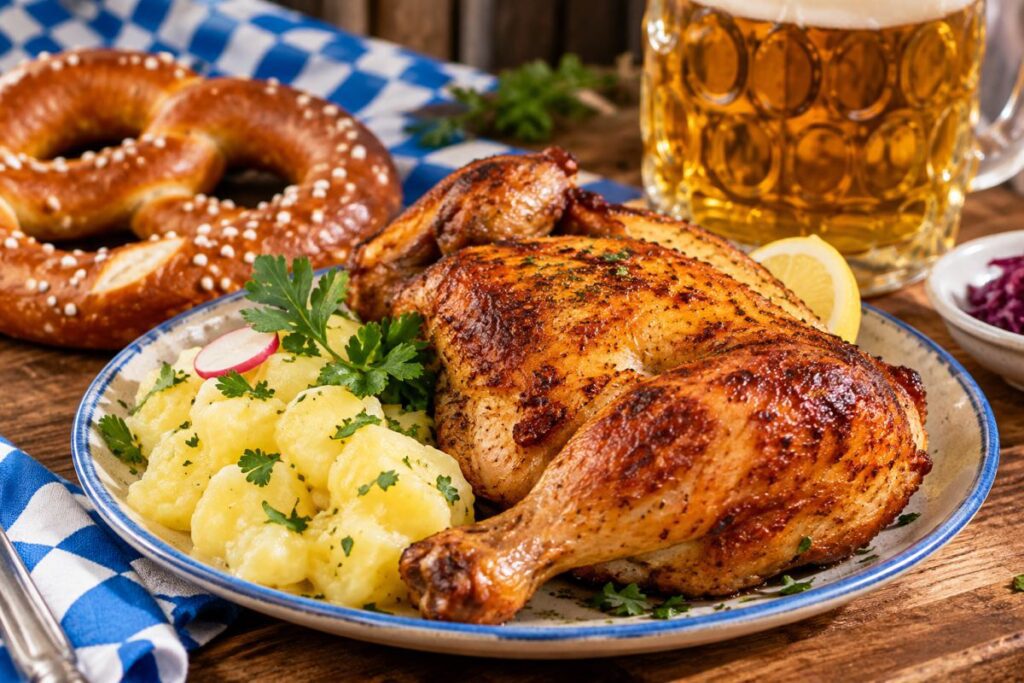
Be careful with chicken statistics. Some travel sites claim 500,000 to 600,000 a year. According to a 2025 facts round that brings in numbers from 2024, the number would be approximately 370,000. Repeat the first or second if they are the same: Cite a source and a year.
2. Schweinshaxe (Pork Knuckles)
Pork knuckles are the heavy hitter. The skin turns into crackling, the meat comes off the bone, and it’s served with dumplings and gravy, or with sauerkraut. Servings are large; consider serving half if you plan to still eat dessert later. According to the same roundup, approximately 60,000 knuckles a year.
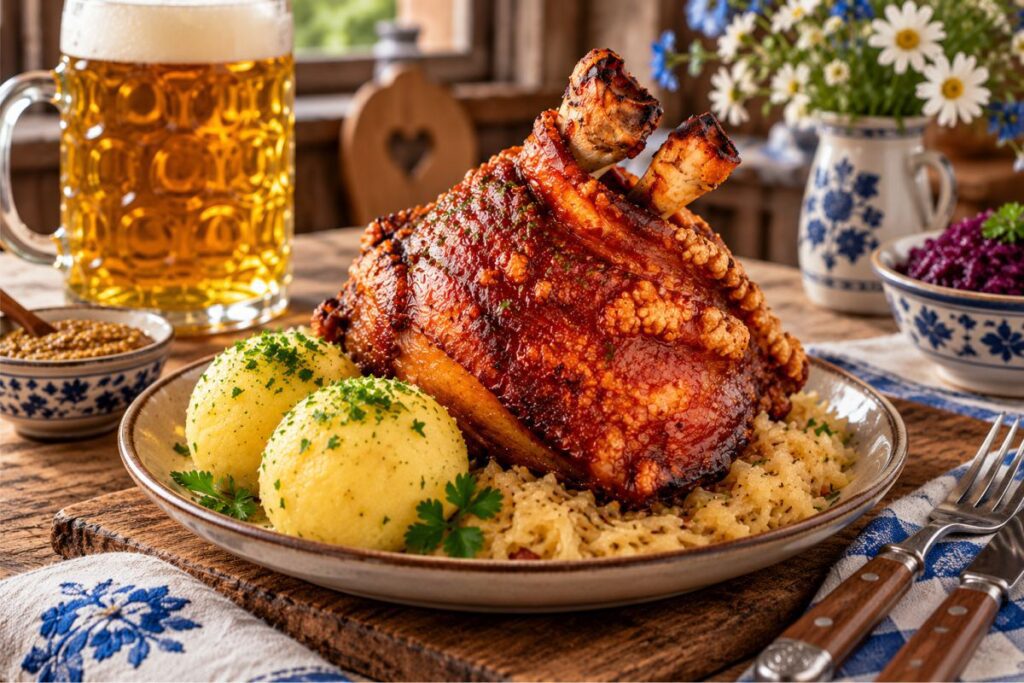
Not to be confused with Schweinsbraten, sliced roast pork shoulder with dumplings and gravy. Only choose the chicken or the knuckle – not both – if you are only eating one meat dish.
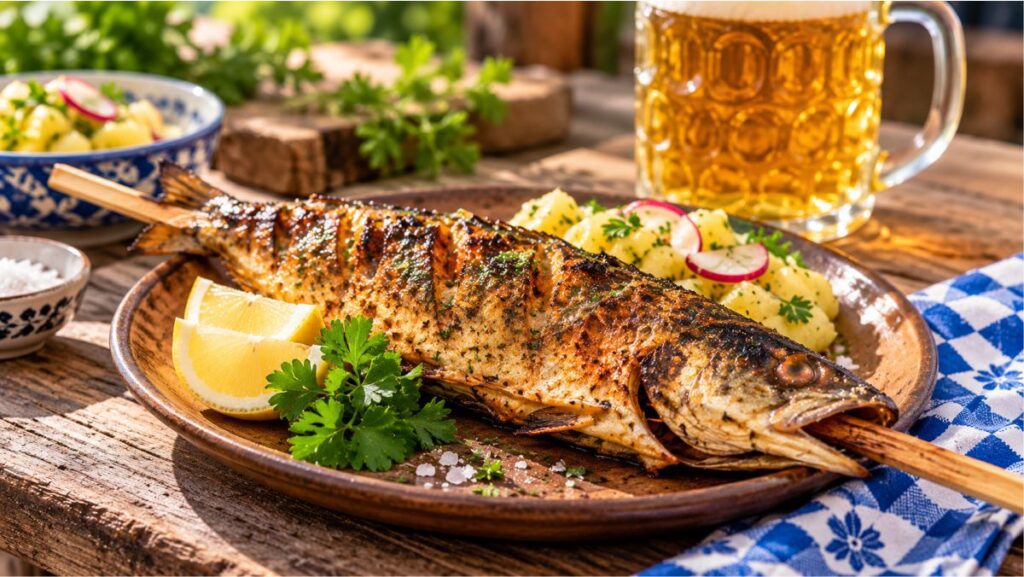
3. Steckerlfisch
Steckerlfisch is a whole fish on a stick, usually mackerel, trout or whitefish, grilled over hot embers. Fischer-Vroni is the tent best known for serving it, and it keeps the old method of grilling over a ground fire. Peel back the skin and eat it with your hands. It works on a warm day and suits anyone skipping red meat. The catch is bones, so go slowly.
4. Käsespätzle: Oktoberfest’s Mac and Cheese
Käsespätzle is a soft egg noodle filled with melted cheese (traditionally Emmentaler) and served with fried onions. While not quite mac and cheese, this is the most mac and cheese-like of Oktoberfest’s offerings, but not the gloop-filled kind. It’s also the standard meatless main. Some versions come with bacon, so ask before you order.
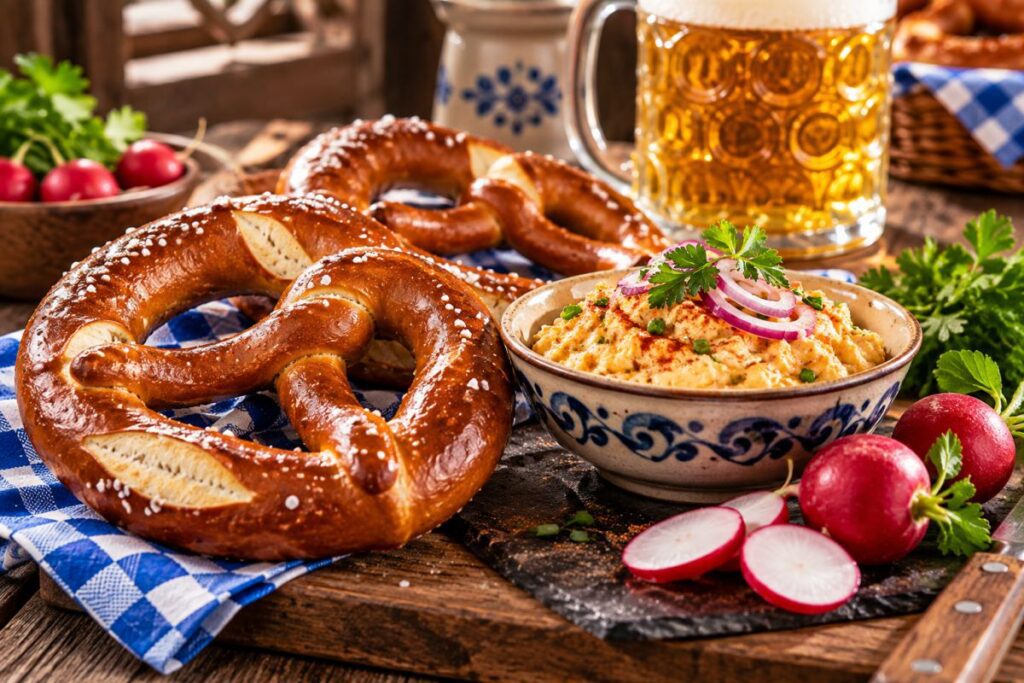
5. Pretzels, Obatzda and Radi
These three make a classic cold starter. Brezn, the Bavarian word for pretzels, are huge and chewy, often carried between tables by walking vendors, and they cost about €5 to €8. Obatzda is a spread made from ripe Camembert, butter, paprika, and onion that you scoop onto the pretzel. Radi is white radish cut into a long spiral and salted, adding a fresh, crunchy bite between mouthfuls. It’s an affordable way to enjoy a classic Oktoberfest beer-tent combination, and all three are meat-free.
6. Weißwurst, Bratwurst and Other Sausages
Weißwurst is a traditional white sausage made with veal and pork, traditionally served in hot water. You peel off the casing, dip the sausage in sweet mustard, and eat it with a pretzel. It’s traditionally served as a morning dish. Pork sausages with sauerkraut are another simple and reliable choice. Currywurst is not a traditional Bavarian dish, so you won’t find it as a classic Oktoberfest specialty.
7. Ochsenbraten (Roast Ox)
Ochsenbraten is a traditional German and Bavarian pot roast made from ox meat, slowly braised until tender. At Oktoberfest, it is especially associated with the Ochsenbraterei, the Spaten tent famous for roasting whole oxen on giant rotating spits. City statistics recorded 142 oxen consumed at Oktoberfest in 2023. It’s a good choice if you want a rich, hearty Bavarian meat dish.
8. Sweets: Kaiserschmarrn, Roasted Almonds and Lebkuchen Hearts
Kaiserschmarrn is a shredded, caramelized pancake served with plum compote or applesauce. In Bavaria it can be a main course. Café Rischart’s version is a well-known Wiesn favorite. Roasted almonds are the most popular sweet snack, best eaten still warm. You’ll also find plenty of traditional German sweets, from classic Bavarian treats to festive gingerbread, at Oktoberfest.
Lebkuchen hearts are decorated gingerbread that people wear or give as gifts. Most guides say they’re a souvenir, not a snack.
Oktoberfest Food Prices: What to Expect in 2026
Prices vary by tent, and there’s no single official food price list. These are ranges reported by 2026 travel guides:
| Item | Typical range |
| Full meal in a tent | €12 to €35 |
| Half chicken | €18 to €25 |
| Sausages | about €11 |
| Giant pretzel | €5 to €8 |
| Leberkäse roll (stall) | €5 to €7 |
For comparison, beer cost €14.50 to €15.80 per Maß in 2025.
Three ways to spend less:
- Eat at lunch. Midday prices are generally lower than evening ones.
- Buy from booths. Food from stalls outside the tents costs noticeably less.
- Skip the Schnitzel. Fried dishes in the tents can run about 50 percent above regular restaurant prices.
Which Beer Tent Serves What?
Each tent runs its own menu, so tent hopping works as a food plan: one dish per tent. A few anchors:
- Ochsenbraterei: roast ox.
- Fischer-Vroni: Steckerlfisch.
- Käfer Wiesn-Schänke: pricier menus, including duck and venison.
- Weinzelt: more modern, with vegetarian and vegan dishes.
Check each tent’s own menu before you go, since dishes and prices change from year to year.
How to Order, Pay and Eat Without the Stress
Ordering food at Oktoberfest is straightforward, but the busy beer tents can make the experience feel hectic. Check the menu and prices before ordering, then tell the server what you want. If you’re sitting at a table, food and drinks are usually brought to you.
Cash is useful, especially when buying food from smaller stalls around the festival grounds. If you’re eating inside a tent, keep your table number or location in mind so your server can find you easily.
The biggest challenge is finding a place to eat during busy periods. Weekday lunchtime is generally quieter than weekend afternoons and evenings. If one tent is full, try another tent or a food stall rather than waiting too long.
Food Stalls, Food Trucks and Cheaper Ways to Eat
Along the Wirtsbudenstraße you’ll find wooden stalls selling cold sausages, fish rolls, cheese, Leberkäse and Schnitzel rolls. These food stalls are the budget option, and the food variety is wide.
For an Oktoberfest food truck, the picture is different. Munich relies on tents and permanent booths. Trucks are more typical of Oktoberfest events elsewhere, so check the vendor list for your event.
If the grounds are too crowded, try the WirtshausWiesn. More than 40 Munich pubs serve the festival’s golden Festbier and classic dishes such as Hendl, Steckerlfisch and vegetarian options. It’s a good backup for Oktoberfest food in Munich without the queues.
Oktoberfest Beer and Food Pairings
Oktoberfest beer today is a golden Festbier, not the amber Märzen many guides still describe. The six Munich breweries brew it with extra original gravity. The six are Augustiner, Hacker-Pschorr, Hofbräu, Löwenbräu, Paulaner and Spaten.
Pair Festbier with Hendl, sausages and pretzels. Weißbier goes well with Weißwurst. A Radler is a lighter choice if you’re pacing yourself.
Host an Oktoberfest Party at Home
You don’t need a marquee. Pick four or five dishes and make most of them ahead. A solid menu for a group: pretzels with Obatzda, a Brotzeit board, bratwurst with sauerkraut, potato salad, and Kaiserschmarrn or apple strudel for dessert.
Fingerfood and Platte ideas (Oktoberfest essen). For Oktoberfest essen und trinken at home, think pretzel sticks with Obatzda, cubed Leberkäse and a Brotzeitplatte with radish, pickles and cheese.
Quantities. As a rule of thumb for planning (not an official figure), count on one to two pretzels and two sausages per guest, plus a spoonful of Obatzda per pretzel. Round up if guests will be drinking.
Quick Oktoberfest food recipes: bratwurst with sauerkraut
- Brown the sausages for about three minutes per side. They don’t need to cook through.
- Fry sliced onions in butter, then stir in a little honey and flour.
- Add beer and beef stock, then simmer.
- Add the sauerkraut and sausages, cover and cook on low until done.
It tastes better the next day. If you use American sauerkraut, drain and rinse it first, because it’s much more vinegary than German-style.
If you can’t find ingredients locally, a German grocery or an Oktoberfest shop will have pretzel mixes, mustard and Obatzda. For the full Oktoberfest look, some hosts also wear traditional men’s Lederhosen or a dirndl.
Oktoberfest started as a Volksfest, a folk fair, with carnival rides next to the beer tents. Food is half the point of the day, so treat the menu with care.
Oktoberfest Food FAQ
What food is served at Oktoberfest?
Roast chicken, pork knuckles, sausages, pretzels, Obatzda, Käsespätzle, Steckerlfisch, roast ox and sweets like Kaiserschmarrn.
What should I eat first?
Start with a pretzel and Obatzda, then share a Hendl. Save sweets for later.
How much does Oktoberfest food cost?
Most tent meals run about €12 to €35, with half chickens around €18 to €25. Booths and lunchtime are cheaper.
Is there mac and cheese at Oktoberfest?
Käsespätzle is the closest dish: egg noodles with melted cheese and fried onions. Ask about bacon.
Where can I eat Steckerlfisch?
Fischer-Vroni is the best-known tent for it, and some stalls sell it too.
Can you bring your own food?
Booth food is traditionally fine in beer gardens, but don’t count on it in the tents. Check the official site.
Are there vegetarian options?
Yes: Käsespätzle, potato pancakes, dumplings, pretzels, Obatzda and Radi. Weinzelt leans more modern.
Are there food trucks at Munich’s Oktoberfest?
Munich relies on tents and permanent booths. Trucks are more common at Oktoberfest events elsewhere.

One thought on “Oktoberfest Food: Traditional German Foods You Need to Try”